

Disclosure: We only recommend products we would use ourselves and all opinions expressed here are our own. This post may contain affiliate links and at no additional cost to you we may earn a small commission.
Tennis is a funny game.
One day you can be hitting every shot and winning every point.
The next day, you can’t seem to do anything right.
That’s why it’s important to have a reliable rebound net to practice with.
A tennis rebound net will help you work on your accuracy and improve your tennis game!
The Best Tennis Rebound Net in 2024
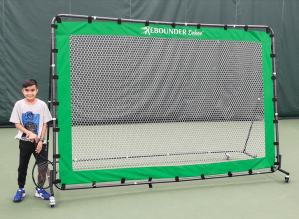
The Rebounder Deluxe is our top choice for a tennis rebound net.
Why?
It’s sturdy and well-constructed, and it’s a piece of equipment that will last you for years.
It’s also one of the more affordable options we’ve seen on the market—you can find it for under $300 at OnCourt OffCourt.
It is rather large—7 feet high, 10 feet wide, and 4 feet deep—but folds flat, making it easy to tuck away between uses.
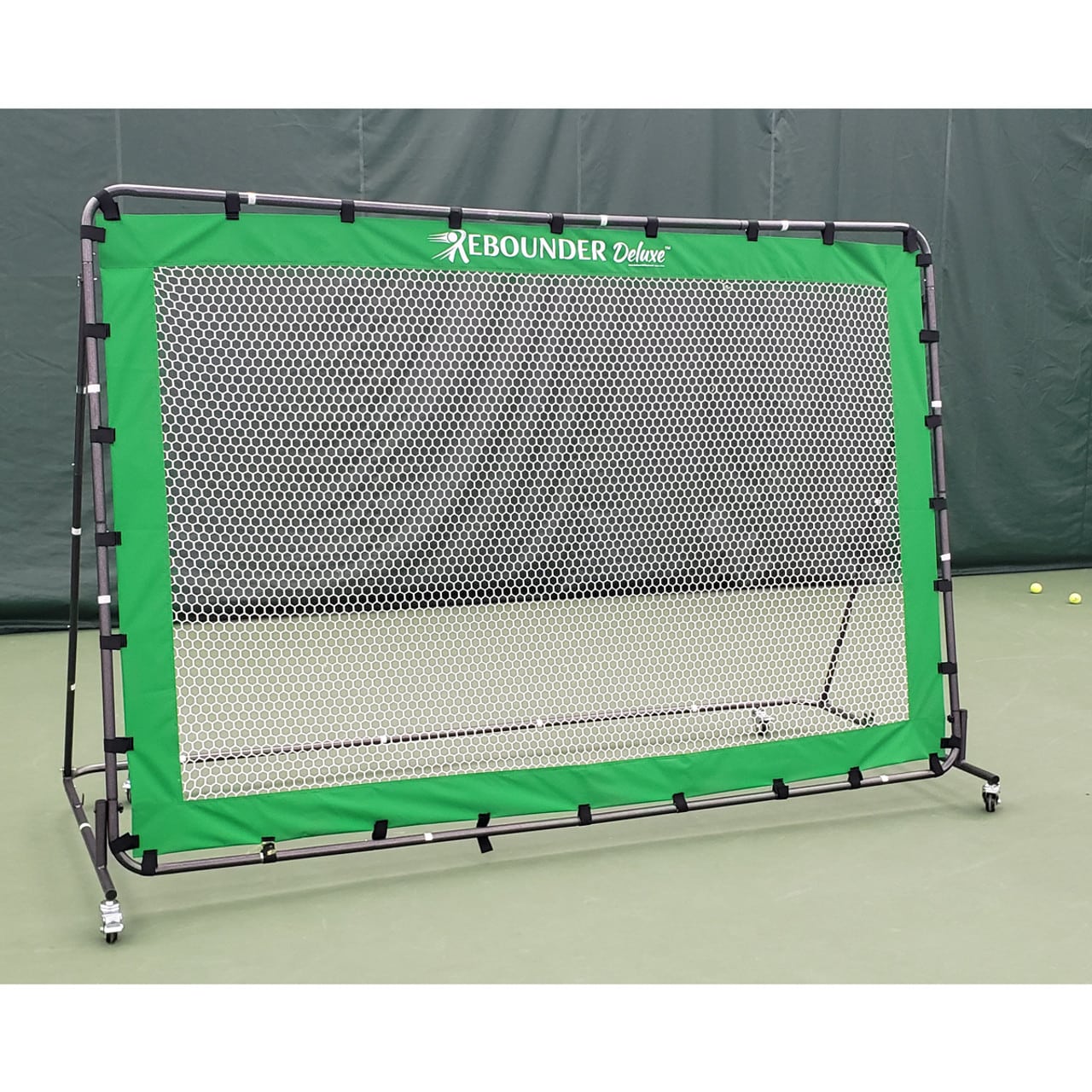
- Adjustable: The Rebounder adjusts from vertical to a 15-degree angle for a realistic rebound
- Power Absorption: Balls will rebound in a very controlled area, making it ideal for all shots, including overheads, serves, overheads, volleys, and more
- Silent: Not only is the Rebounder durable for outdoor and indoor use, it’s also super quiet
- Lockable 4-inch Wheels: Large, durable, lockable wheels close tight when in use but easily move when unlocked

What is a tennis rebound net?
Have you ever been playing tennis and wished for a tennis partner?
Instead, maybe you need a tennis rebound net.
A rebound net is a nifty device that acts as a tennis partner, allowing you to practice your shots without having to find someone to play with.
Essentially, it’s a net that is mounted on a frame and angled to bounce the ball back at the player.
Whether you’re just starting out or trying to improve your skills, this net is perfect for solo practice sessions.
And let’s be real, it can be incredibly satisfying to hit that sweet spot and have the ball come flying back at you like a pro.

What are the benefits of using a tennis rebound net
By using a rebound net, you can minimize those off days.
Consistency is key in tennis, and the rebound net allows you to practice without having to find a partner to hit your balls back!
You can also:
- Improve reaction time.
- Improve hand-eye coordination.
- Provide a realistic tennis experience by simulating the bounce and spin of a real tennis ball.
- Practice your shots without having to go to the court every time.
- Improve accuracy by focusing on specific targets – place those shots better!

What to look for in a tennis rebound net
1. Size
The first thing you need to consider when choosing a tennis rebound net is size.
The size of the net should be proportional to the size of your court.
If you have a smaller court, then you can get away with a smaller net.
But if you have a larger court, then you might want to consider getting a larger rebound net so that you have more space to practice.
2. Your Specific Needs
Another thing to consider when choosing a tennis rebound net is what you need from it.
Do you want a net that will give you a consistent bounce so that you can practice your serve?
Or do you just want a net that will keep the balls from going over the fence and into your neighbor’s yard?
There are nets out there that are designed for different needs, so think about what YOU need before making your purchase.
3. Choose Your Material Wisely
Another important consideration when choosing a tennis rebound net is material.
The most common materials used for these types of nets are nylon and polypropylene.
Nylon is more durable but also more expensive while polypropylene is less expensive but also less durable.
Choose the material based on your budget and how often you plan on using the net.


If you plan on using it every day, then you might want to spend the extra money on the nylon net.
But if you only plan on using it occasionally, then the polypropylene might be just fine.
How to use a rebound net
Simply set up the net on a tennis court (or garage, yard, driveway) and stand facing it as you would an opponent.
Start by hitting your tennis ball against the high section of the net, sending it back to you at various angles.
As you become more comfortable with this move, try hitting different sections of the net to simulate playing against an actual opponent.
And don’t forget to mix it up by using backhands, forehands, and volleys.
- Adjust the tension of the net to control how quickly or slowly the ball bounces back to you.
- Be sure to position the net correctly, with the center hitting area at waist or chest level for maximum effectiveness.
- Always inspect your tennis rebound net before every use to make sure it’s secure and not showing any signs of wear and tear.
Trust me, once you start using a tennis rebound net, you won’t want to stop!
Just be sure to keep an eye out for any rogue balls that may escape.
Tennis rebound net reviews
Rebounder Deluxe
Perfect for: The budget-conscious player
Price: $299.95


Reviewing the design of the Rebounder Deluxe net, it is easy to see why it is one of the best on the market.
The netting is sturdy and well-constructed, able to rebound balls with ease.
This makes it perfect for both tennis (and
The net is large enough to provide plenty of space for you to rally back and forth.
At 10 feet wide (and 7 feet tall), it’s even big enough for two players to practice side by side!
Pros
- Perfect for indoor and outdoor use because it is so durable.
- It’s quiet! Which makes it great for individuals, court owners, and clubs.
Cons
- Unless you’re keeping this at the court (or want to sacrifice your garage space) this puppy is huge! It does fold flat for storage between uses.
Perfect Pitch Rebounder
Perfect for: The player who wants to improve their tennis skills quickly and is up for a challenge
Price: $499.95


Whether you’re in your driveway or basement, this rebounder will help you improve faster than ever before!
It’s a little more difficult to learn to use than other rebounders – but the included instructional videos are useful.
It’s the most versatile rebounder around and can be adjusted to fit players of all levels.
Plus, it sets up in minutes without any tools required (thank goodness).
Pros
- Different settings for beginner, intermediate, & advanced players.
- Easily roll in and out of storage with locking wheels.
Cons
- More challenging than other tennis rebounders.
Infinity Play System
Perfect for: The player who wants a 2-in-1 product
Price: $399

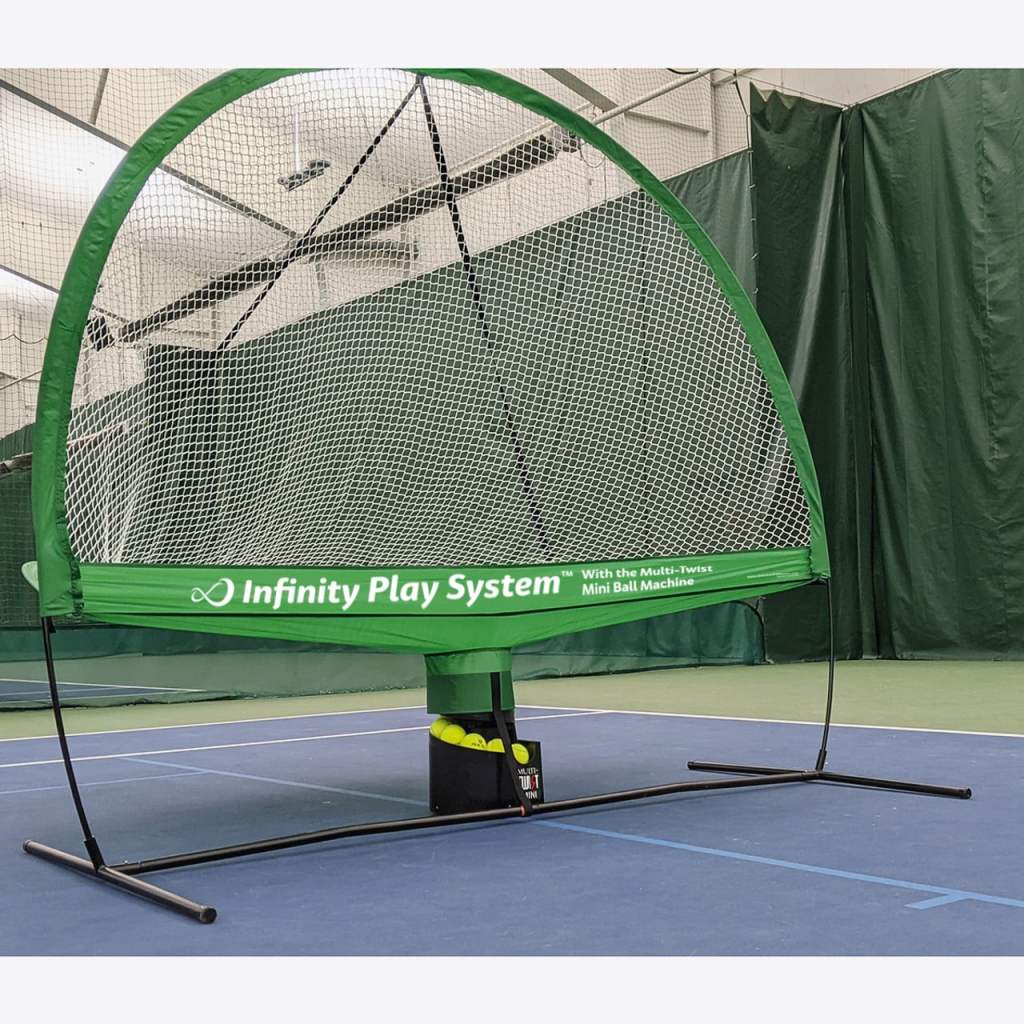
Okay, so this rebound net is a bit different than the rest.
The Infinity Play System includes a ball machine AND the net for $399.
Technically, this doesn’t “rebound” in the sense that it bounces directly off the net back to you.
Rather it directs the ball into the ball machine and launches the ball back at you.
It’s simple:
- Hit or serve your tennis ball into the net.
- The net catches the ball, dropping it into the attached ball machine.
- The ball machine launches the tennis ball back at you to start again.
Pros
- Tennis ball machines are expensive – and this one is included with the Infinity Play system. Even better? You can remove the ball machine and bring it to the court with you – net free!
Cons
- Slower than other rebound nets, so not as great for practicing speed.
Our verdict on rebound tennis nets
Ultimately, whether you’re having an off-day or an on-day, using a rebound net is the best way to improve your game.
Rebound nets are great for practicing your shots so that when you are in the zone, you’ll be able to take advantage of it.
They’re also great for working on your accuracy so that when you’re playing a real match, you’ll be able to place your shots better.
Pair this with your own portable tennis net and you’re well on your way to Wimbledon.
So what are you waiting for?
Get yourself a rebound net and start practicing!


